There is a question at the centre of the global energy transition that is still not being asked clearly enough. What happens when the two largest system level demands on energy and computation arrive at the same time?
The answer shapes every investment thesis in energy today, and it certainly shapes ours.
For the past decade, the energy transition narrative moved along a relatively linear path. Coal would be retired, solar and wind would be built, and transport would be electrified. The capital requirements were enormous, yet the direction was clear.
Then the compute supercycle arrived, which show that AI infrastructure is not a software problem. It is a physical infrastructure problem that consumes energy at a scale and intensity that grid planners, utilities, and climate modellers had not fully accounted for. Data centres are now among the fastest growing categories of electricity demand globally. Unlike industrial or residential demand, compute load is concentrated, continuous, and growing exponentially.

The result is a structural collision. Decarbonisation requires replacing existing carbon intensive generation at enormous scale, while computation simultaneously adds new demand that did not exist in prior energy planning cycles. Both are unfolding within the same decade.
This is not a problem that solar and wind alone can solve. Variable renewables remain essential, yet they do not provide what the combined system increasingly requires, which is reliable and continuous baseload clean power.
This is where geothermal enters the thesis.
Geothermal is not a new technology. It has been generating electricity since 1904. What makes it newly strategic is not novelty, but the specific performance characteristics it brings to a grid under simultaneous decarbonisation and compute pressure.
Geothermal plants operate at capacity factors of 80 to 90 percent. Solar peaks at 20 to 25 percent, and wind at 35 to 45 percent. Capacity factor is not an abstract technical metric. It answers a simple question: When demand is continuous, what energy sources can actually be counted on?

For the type of load that AI data centres represent, which runs continuously, independent of weather and flexible in location, geothermal is one of the very few clean energy sources that matches the demand profile without requiring storage, backup, or grid balancing at equivalent scale
There is also a supply chain alignment that is often underappreciated. Up to 80 percent of geothermal project capital expenditure overlaps with oil and gas drilling, including equipment, workforce capabilities, and subsurface engineering expertise. In a world where the energy transition competes for limited industrial capacity, geothermal can scale using infrastructure that already exists.
Beyond electricity, geothermal heat in the range of 100 to 200 degrees Celsius and above supports industrial processes, district heating, and increasingly green hydrogen production through high temperature electrolysis. The asset is not a single purpose power generator. It is a thermal resource with multiple commercial pathways.
The convergence of energy and computation is global, yet it is most acute in Asia, and particularly in Southeast Asia. Asia accounts for 65 to 70 percent of global clean energy capital expenditure and is also the fastest growing region for AI infrastructure deployment. Indonesia, Malaysia, and the broader ASEAN corridor are actively building data centre capacity to serve domestic digital growth as well as regional demand from hyperscalers seeking to diversify beyond North America and Europe.

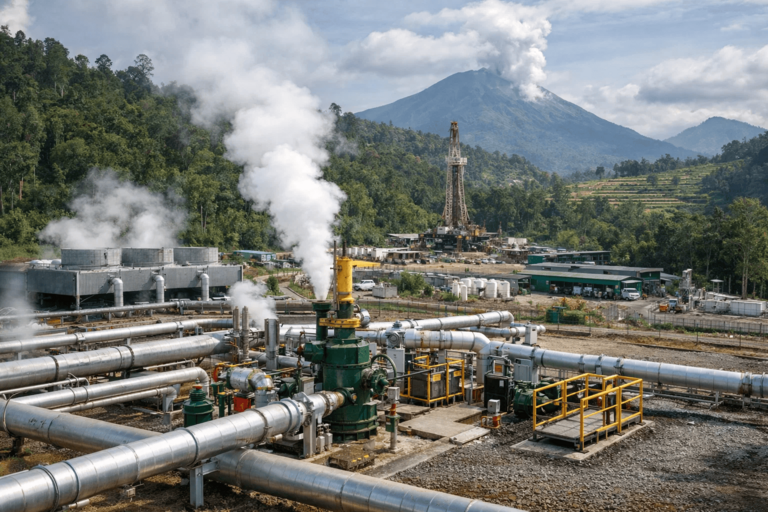
Indonesia’s position within this picture is singular. The country holds 29 gigawatts of geothermal potential, which represents 40 percent of the world’s total estimated resource. It is currently the second largest geothermal energy producer globally, yet it is utilising less than 10 percent of its own reserves.
For decades, the standard explanation has focused on regulatory friction, conservation area overlaps, utility company’s least cost mandate, and the exploration financing gap that commercial banks are unwilling to cross without government support. These explanations are accurate, yet they describe symptoms more than the underlying cause.
The utility companies operates under a least cost mandate. Within that framework, geothermal’s capacity factor of 80 to 90 percent, its ability to produce power continuously regardless of weather, is not treated as a premium attribute. It becomes a cost input that must compete with subsidised coal. The tariff negotiations that have stalled projects for years are therefore not anomalies. They are the logical outcome of a procurement system that cannot price reliability.
That buyer is no longer alone. Google’s partnership with Fervo Energy in Nevada and Meta’s 150 megawatt agreement with XGS Energy for its New Mexico data centre campus are procurement decisions shaped by a specific technical requirement. These organisations require continuous, large scale clean power for AI infrastructure that operates independent of weather and cannot be served by intermittent renewables without storage at equivalent scale.
For the first time, there is a class of buyer willing to pay for what geothermal actually delivers. Yet the basis on which that performance is achieved remains difficult to value.
In Asia Growth Market, this shift is moving from concept into commercial discussion. Star Energy Geothermal, which operates more than 900 megawatts of installed capacity, has confirmed conversations with data centre operators about co locating facilities adjacent to its plants. Project InnerSpace’s 2025 analysis identifies Batam as a site capable of supplying firm geothermal power to Singapore’s constrained data centre market across the strait. PLN projects Indonesia’s data centre load reaching 4 gigawatts by 2033, with AI likely to accelerate that trajectory further.
Pertamina Geothermal Energy has stated its strategy of bringing global geothermal technology into Indonesia and localising it. Its partnership with Genvia on solid oxide electrolyzer technology for green hydrogen production reflects a recognition that geothermal is a thermal platform with multiple outputs, not only a power generator tied to a fixed tariff.
Star Energy Geothermal has partnered with SLB to address subsurface characterisation and drilling economics. Previous field work in Indonesia shows well costs reduced by 70 to 75 percent and drilling rates increased from 44 to 112 metres per day. These improvements come from applying oilfield grade technology and data analytics to a sector that has long operated with older methods.
Pertamina Geothermal Energy has also developed its Flow2Max two phase flow measurement system for international market. When the largest operator in the region builds its own productivity tools, it signals that the technology supply chain remains thinner than the asset base requires.
Conventional geothermal — binary cycle, flash steam, dry steam — is what built the 2.4 gigawatts Indonesia and most other growth market in Asia operates today. It is reliable, proven, and increasingly well-financed. State infrastructure financing institution has built an entire risk-mitigation facility around conventional exploration drilling. The capital ecosystem for conventional geothermal is maturing.

Asia’s current innovation wave reflects this reality. This includes binary cycle systems that extract additional generation from residual brine without new drilling, advanced reservoir imaging such as Geo Dipa’s collaboration with Geo Flow Imaging from New Zealand, and Elnusa’s RES IP device developed with ITB for geothermal formation characterisation below sub volcanic geology. Flow systems that stabilise well productivity prediction are also part of this layer. These are near term commercial priorities for concession holders, and the incumbent solution set remains underdeveloped relative to demand.
Antares is not investing in what is already being financed. Our thesis sits in the technology layer that unlocks the remaining 90% of Asia’s geothermal potential, and the equivalent opportunity across the Ring of Fire markets we cover.
1. Enhanced Geothermal Systems (EGS) use directional drilling and controlled subsurface stimulation to create permeability in hot rock, expanding viable geothermal sites far beyond naturally permeable, high-temperature reservoirs. EGS makes geography flexible. The heat exists almost everywhere at sufficient depth — EGS is the technology that makes it accessible.
2. Closed-Loop Systems circulate working fluid through sealed subsurface heat exchangers, eliminating the need to find a naturally permeable reservoir entirely. They reduce exploration risk, preserve reservoir integrity, and bring a fundamentally different risk profile to project development compared to conventional systems.
3. Supercritical Drilling targets temperatures above 370°C at depths beyond five kilometres — dramatically increasing energy density per well. It requires breakthroughs in materials and well design, but the energy output per well makes it potentially transformative at scale.

What ties these three together is ORC efficiency. Organic Rankine Cycle efficiency — the measure of how effectively geothermal heat is converted to electricity — ranges from 5–15% in conventional systems, to 15–20% in EGS, to 15–30% in closed-loop configurations. Better drilling and heat recovery technology does not just expand where geothermal can go. It changes the economics of every project.
At Antares, our investment focus sits in the layer between the resource and the output. We invest in industrial deep technologies that determine performance across real world systems operating under constraint, and global proof points are now emerging. Fervo Energy drilled its Sugarloaf appraisal well to 15,765 feet in 16 days, representing a 79 percent reduction against the US Department of Energy baseline, with thermal recovery factors of 50 to 60 percent. Cape Station Phase I is expected to come online in 2026 with 400 megawatts contracted to investment grade buyers. These developments indicate that EGS and other technology is moving from research into a commercial asset class.

The window for this investment is not indefinite. The convergence of energy and computation is accelerating demand for reliable clean baseload power. Hyperscalers and data centre operators are actively seeking continuous clean power purchase agreements. This creates a new category of offtake demand that geothermal is uniquely positioned to serve, provided next generation technologies mature in time.
At the same time, the oil and gas industry is actively redeploying drilling expertise, subsurface engineering, and workforce capabilities into geothermal. The companies best positioned to absorb this transfer are the deep technology ventures building next generation systems.
In Asia’s Growth Market, policy and financing infrastructure is also being built in the current cycle. Risk mitigation facilities, blended finance structures, and government mandates for geothermal development are taking shape now. Technology companies that establish relationships within this ecosystem during the current phase are positioned to scale as next generation systems reach readiness.
Within the Antares framework, geothermal technology investment in Asia sits within an industrial performance thesis, using the same lens we apply across our energy systems portfolio. It reflects a structural alignment between a resource that is abundant and geographically concentrated in Asia, a demand profile shaped by the convergence of energy and computation, a technology transition that moves from conventional systems toward next generation access and efficiency, and a regional ecosystem that is actively preparing to deploy these technologies at scale.
We are looking for founders working on the specific technical problems that Asia’s operators have revealed through their own behaviour: drilling efficiency and cost reduction in geothermal-specific geological conditions, subsurface characterisation that reduces exploration risk at scale, binary and ORC efficiency improvements that improve project economics without new wells, and reservoir stimulation and permeability engineering that expands the viable resource base.
We are particularly interested in founders who understand that the customer acquisition challenge in this market is as technically demanding as the product itself. The operators are sophisticated, the procurement cycles are long, and the path from technology demonstration to embedded asset contract requires navigating institutional structures that most deep-tech founders have not encountered. We have seen how this works across adjacent sectors, and we bring that context to the conversations we have with founders in this space.
The buyer has changed, and the operators are responding. The technology supply chain that serves them is being built right now, and the companies that establish themselves in this ecosystem during the current phase are the ones positioned to scale when the demand signal fully arrives.
If you are building in this space, we would welcome the conversation.