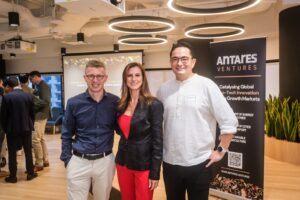
What does conviction really look like in deep-tech investing? In this podcast episode of The Impact at Scale with Zal Dastur, our Founder and Managing Partner Michael Gryseels shares Antares’ approach to working with founders, shaping theses early, and backing science when it’s ready to scale.
We focus exclusively on early growth deep-tech, where science meets scale and operational value creation is essential.
On the podcast, Michael also shares three beliefs shaped our investment approach:
1) We lead with thesis and research. We invest behind structural shifts and scientific inflections, not short-term trends.
2) We’re hands-on with commercialization. From localization to supply chain to regulatory paths, we work side-by-side with founders to move from proof to product.
3) We’re embedded in Asia’s growth. More than connecting startups to Asia, we help embed them into its systems and scale where it matters.
As Michael puts it: “We try to identify what the biggest problem statements are that are unsolved, for which there is innovation available today, and we look for the most impactful innovation out there that we can find.”
You can hear the full episode below. on Spotify or Youtube For more on how conviction shapes early decisions, follow our insights on LinkedIn.
Prefer to read it in full? Below is the lightly edited transcript for deeper reading.
Hi, everybody. Welcome to the Impact at Scale podcast. My guest today is Michael Gryseels, the founder of Antares Ventures.
Antares is a deep-tech investment fund built on research and data-driven conviction. Before launching the fund, Michael was a private investor and a managing partner at McKinsey. Now, he’s focused full-time on backing breakthrough science and technology.
What makes his approach unique is that he starts with the problem, builds a thesis, and then finds the solution to fund. We’re looking forward to talking about all things deep tech in this episode.
Welcome to the show, Michael.
Thank you for having me, Zal. I look forward to it.
Thank you so much for coming. When we spoke earlier, you told me about the thesis for the fund, which is what you feel really sets it apart from other deep-tech funds. Can you go a little bit deeper into that?
Sure. I think two things.
Number one, after decades working more as an operator, I saw that I could make more impact by enabling distinctive founders. This is particularly true for deep-tech founders that often have a great technical solution but need both the capital and the corporate introductions to scale their solution in the market.
Secondly, having lived here now for 15 years, I’m very fond of Asia, but I also notice a lot of the biggest problems around here—energy, water, food, healthcare—are being underfunded, particularly from a venture perspective. You don’t see as much capital going into breakthrough solutions in these spaces.
So what I did with the fund was to try to combine my experience as an operator and how I’ve scaled technology businesses myself, and at the same time, take an impact focus, addressing some of the biggest structural challenges of Asia.
I’m curious, in terms of your investment strategy, when you talk about it being thesis-driven, what does that mean in practice?
Well, the biggest mistake that I’ve seen people investing in deep tech do is they fall in love with a technology. It looks very groundbreaking, but they forget to check whether there’s actually a commercial market ready for that solution. Typically, they would invest ahead of the curve.
So, from our fund’s perspective, we want to scale solutions for which there is unmet demand here and now. We also want to tackle the biggest problems. I always say to my team, “Our biggest constraint is not capital, it’s the time that we have.” So we have to make sure that we spend it with those companies that can have the biggest impact.
When I say we’re a thesis-driven fund, what I mean is that we spend a meaningful amount of our time doing proprietary research around those big problem statements: energy, water, food, healthcare, and resilient cities. We research what the biggest unsolved problems are for which there is innovation available today. We try to identify the most impactful innovation out there that we can find.
Our investments are guided by that. To make it very simple, if you’re a founder knocking on our door and you don’t fit with any of our theses, we’re probably not going to spend time with you. In contrast, for the theses that we think are very important, we will look globally for the very best startup and founders to provide that solution.
How deep does your research go before you decide to make an investment? Could you talk us through what that process looks like? From starting with a problem statement, developing a thesis, searching for a company, and then finally deciding, “This is the one”?
Absolutely. Let me go through a recent journey. Last year, we built a thesis around the future of the grid in Asia. We had identified that one of the biggest bottlenecks for having more renewable energy in Asia is the grid and the fact that it is, relatively speaking compared to Europe and the US, underfunded and underdeveloped.
We identified that one of the biggest choke points was the connection of renewables to the grid on both sides. On the generation side, solar and wind are intermittent, and the grid can’t handle that well. On the distribution side, people are introducing EV charging or other types of unpredictable loads. In the past, you had a very predictable pattern: people came home, switched on their lights, their air conditioning, their TV. That’s not the case today.
We then zoomed in on what the big control points were from an innovation point of view and identified electricity transformers as one area that constituted a real demand. We spoke to several utilities in Asia and other power players, and they all told us that they had to wait an average of two to three years before they got a transformer after ordering it. They also complained that current transformers can’t deal with that intermittency.
So then we zoomed into transformers. Surprisingly, we only found about a dozen companies globally that innovated in that space. We did an outside-in review of all of them, started talking to the three or four we liked the most, did due diligence on two, and finally narrowed it down to one in which we’ve invested. It was a UK company spun off from Oxford that we thought had the most practical solution to the problem. Their product was ready, they were ready to scale, and importantly for us, the founder was Australian with an affinity for Asian markets and wanted to enter them.
We entered as their first Asian investor on their cap table and are now helping them land and expand in Asia. So that’s an example of the journey we go through: from figuring out a big unsolved problem to understanding the global innovation landscape, looking at everyone, and then zooming in on one or two to make an investment.
To look at that a little further, it’s a very interesting use case. The main issue you were looking at was energy, and you said, “Okay, what is the gap here?” This is where your firm stands apart from most other investment firms—you went out and spoke to a lot of people. I guess this is where your deep experience in management consulting with McKinsey is very helpful because I imagine there’s a lot of research that goes into that.
From what I understand about transformers, and my knowledge is limited, almost every electricity provider in the world has its own custom-built transformer for that particular system. Someone was saying in the US alone, there are something like 15,000 different models of these step-up or step-down transformers.
It’s very fragmented. It was insightful when we got into it. There’s been so much innovation in wind, solar, and batteries, but the transformer industry is, as you said, very fragmented. There are a lot of medium-sized companies that make them and a few big companies with some IP, but fundamentally, the transformers in the grid are the same as they were 30 or 40 years ago. In fact, in most cases, that’s their actual age. And there are plenty of them; for example, in the UK alone, the network has about 150,000 transformers.
What surprised us is that almost no one has innovated in that space, except for a few. To illustrate what’s different about our approach, when we spoke to the founder of Ionate, the company we invested in, he said that he’d never met an investor that was so educated on the space. We could tell him about the problem statements, the size of the market, the players in Asia. He was blown away. He had never met an investor like that who came to him with an educated view, as opposed to him having to typically educate the investors on what transformers are and why they’re important.
So yes, our approach, particularly the first part of investing, is closer to that of a consultant. It’s a very data-driven approach to take away biases and avoid getting excited about things that could be very cool but aren’t really solving a big problem.
My background is in sales and being a founder, not consulting. One of the most important lessons in sales and developing partnerships is that you have to make the person across the table feel like they are the most important person in the world. I can imagine having an investor who has deep market knowledge on your specific industry is incredibly rare.
In the typical investment world, and I coach and work with a lot of founders, you’re trying to convince the investor that this area is worth looking at. To have somebody sit down and say, “Well, I’ve already done hours of research here, and I know this area very well,” must be so uplifting for a founder. It must really make you feel like you’re on the same side.
Yes, and that’s often the feedback we hear. People are surprised by how much we know about their space in that first conversation. That doesn’t mean we’ll just invest like that. In this case, we spoke to many before we decided to invest. In some cases, we develop a thesis and decide not to invest at all.
But as you said, the majority of these technical founders come from academia or research. They have spent their entire lives on that problem from a technical point of view. They are very convinced because of the sheer amount of energy and mindshare they’ve given to their invention. But they’ve rarely taken an outside-in approach to see what the actual market is for this invention.
To meet someone who can complement that is valuable. To be honest, we don’t try to second-guess what they should bet on from the technical side. We do the technical due diligence to make sure it’s the very best out there, but afterwards, we typically trust our founders on the technical development. However, on the commercial development, I’ve noticed again and again that the majority of the founders we work with are learning a lot as they go about their market. As you said, they’re naive about go-to-market, and that’s okay.
That’s where Antara comes in. We don’t want to make mistakes by investing in startups that don’t have a market. When we do invest, we come in with an educated approach so that after the investment, we can be as impactful as possible by making introductions to the right people, helping them tailor their pitch—which is probably what you do in your consulting work—and making sure they speak to the right people.
You’re absolutely right. I do so much work with founders, VCs, and accelerators for the reason you mentioned. The people doing the really impactful, transformational development tend to come from an academic or scientific background because they have spent their whole life in that one space trying to solve that problem.
What I’ve noticed is that they come from a space where there is a very clear pass-fail, yes-no, good-bad. If you can show your evidence, the answer is either right or wrong, with no middle ground. Whereas when it comes to getting an investor, finding a partner, bringing on employees, or even making a sale, telling a client, “Hey, I’m 10% more efficient,” doesn’t usually move the needle enough for them to say, “Take my money now.”
It’s about helping them understand how to contextualize what they are doing, especially for investors. With customers, it’s different. If you’ve done this right, you should know who your customers are and you can talk to them. But when you’re going to an investor, especially a traditional non-climate VC with a whole spectrum of investments to look at, you have to convince them why your area, your industry, your Total Addressable Market (TAM), should be the one they’re worried about. That’s where they really struggle.
Oftentimes, these are some of the smartest people I’ve ever met. When they’re trying to communicate, they’re almost talking at a level that is so much higher in terms of knowledge and awareness of the topic than the investor or the customer. That can cause friction points in the sales process.
I empathize. I’m a PhD myself. I used to make lasers in a lab many years ago, so I understand these people. You have to relate to them as people who have spent 10 or 15 years in a specific domain. They can typically articulate very well why their invention is unique. But as we both know, that’s different from a commercial value proposition.
Most customers don’t really care whether the technology is A, B, or C. They’re looking at unit cost, performance, or reliability. Those are the things a customer cares about. Even most VCs, I would say… the category of deep-tech VCs is still nascent in Asia. We’re one of very few. The majority of investors out here take a more general approach, so what they know is revenue. And these companies, at the time we invest, often have no revenue.
You’ve got to be able to make an investor understand why this problem is commercially relevant and why you will take market share. Their narrative is often very technical-first as opposed to customer-first. That’s what you would coach them on. That’s why it’s very hard for most of them to raise from what I call generalist VCs.
In our case, because we’ve spent time understanding the problem statements, we come in with a view. So even if they’re not able to articulate their market, at least we have an educated perspective coming in. That’s why we are comfortable making that bet, as long as we’re convinced that the market is there through our research and that the product they’ve built is ready to scale.
One of the biggest hurdles I face with these clients is that what they have been optimizing for their whole career, and the reason they feel their solution is the perfect fit, is rarely the reason the customers are looking to buy.
I often tell them about the stat that eight out of ten startups will fail within the first few years. Of the ones that make it, eight out of ten will fail in the next five. What you’re really selling is the fact that you’re going to be there five or ten years later. Imagine working for a power company; their goal is to minimize risk as much as possible because any issue means a blackout. You’re selling security, safety, and reliability. It’s not even the product; you’re selling yourself and the fact that you’ll be around. When that guy is still there in three or four years, he can’t turn around to his boss and say, “Oh, that company we worked with just went out of business.”
Going back to what you said about deep tech being pre-revenue, and sometimes I’m guessing you’re investing before there are even proof-of-concept customers. That’s a huge amount of risk, especially considering how long it takes to get that money back. Deep tech is hard to fund and slow to scale. What makes you optimistic about this particular investment category?
Let me add some nuance to that. From a timing point of view, and this is very hard to get right, we look to invest when the product is commercially mature. This typically means they’ve already had some interactions with customers. We would rarely invest in a startup that is still in the lab and has never met a customer. Part of our investment committee decision is which corporates have actually used this solution and what their feedback is.
The second thing we look at is the market they play in and the trajectory to scale. The good thing about the problems we’re focused on—energy, food, infrastructure, cities—is that these are massive markets. Everyone talks about AI, but just consider growing incomes in this part of the world. As people have more income, they get air conditioning, they buy an EV, so the demand for energy is skyrocketing.
All of these startups, for example in the renewable energy space, are in a market worth billions of dollars. If you have the right solution, you can scale very quickly. Our transformer company, for instance, has customers asking them, “Can you build me 500 transformers in the next year?” Their challenge right now is more on the delivery side.
We look for startups that have a really unique solution to a problem here and now. Where we spend our time is helping them figure out how to pitch it to the right people with the right story and business model. Then, scaling can happen very quickly. I actually think some of these startups can scale faster than general software startups. Many people talk about software, but the reality is that in Asia, software is a small market. Compare what companies spend on software versus what they spend on energy; it’s just a fraction.
The reality is that VCs have gotten used to software, so they know how to underwrite it. The problem with deep tech is, how do you underwrite it when the only thing you have is a product and a few customers that said, “Yeah, this looks good”? That’s an art, and that’s why there are few people who can actually do that. It’s very hard for those founders to raise at that stage. But when we come in, we’ve seen it, we’ve been able to unlock growth from less than a million in revenue to 10 million in revenue in two years. And from there, it can scale very, very quickly.
So I would say, if you focus on the right spaces and pick the right startups, this does not need a long gestation period. But it takes a very hands-on approach and an investment approach where you’re able to underwrite the technical side, confirm that the solution is de-risked, and underwrite the commercial risk by having a deeper understanding of the market. I believe this is a very investable category, as long as you know what you’re doing and do your homework.
What you’re saying is very true. When it comes to traditional investments, people understand the software model, and in Asia, they understand there can be exits from that space. But in this whole market, especially for climate, where have the big blockbuster exits been? There are very few. The ones I know of, where big companies have bought businesses, tend to be in the ESG reporting space.
What is exciting you? What is the breakthrough technology you’re seeing out there? You’re on the forefront of looking at the next generation of technology.
Let’s talk about some of the thematics. Take energy, for example. With respect to the energy transition, Asia is where Europe was in the 80s. 90% of the energy is still from fossil fuels, whereas some countries like Spain and Portugal run on 100% renewables some days. The energy transition is still in its early stages here.
At the same time, what’s driving the transition in Asia is actually demand outstripping what you can build with coal. Just like in China, they’ve gone massively into renewables because they needed it for their manufacturing industries, their EV industry, and their consumers. You add AI to that now, and I think most of Asia has a structural energy deficit. That is just going to unlock a lot of investments. For the right startups that tap into those places, they can absolutely scale.
My belief is that when a company reaches a massive scale, there should be exit opportunities. We’ve seen exits in the space, typically on the early side, where our companies have been acquired by strategic acquirers because of their IP. So I don’t think there are no exits. Whether you see the blockbusters, I think that’s still a few years out, but the market is definitely there to facilitate them.
I can go to other thematics. Let’s take food. Most of Asia has a food security challenge. Most Asian countries, including developed ones like Japan, Korea, Hong Kong, Singapore, and Malaysia, all import food. In some cases, it’s a lack of land; in others, it’s just very low agricultural yield. India, Indonesia, and the Philippines still import food, and it’s a massive priority for their governments. So I do think that the right innovations that help increase agricultural yield and at the same time make it more sustainable can scale.
Same for healthcare. Most of Asia is still behind in terms of healthcare infrastructure and clinicians. At the same time, healthcare spending is growing at more than double digits because as consumers get more income, that’s one area they start to spend more on.
So in each of these markets, there is a growth tailwind of at least double digits. Our thesis is that if we find the right companies that address unsolved innovation gaps that are relevant here and now, they can ride that tailwind, and that should result in blockbusters over time. That’s what we believe in. Obviously, the proof is in the pudding, but we’ve already seen in the companies we’ve been involved with for a couple of years that we’re able to scale them to meaningful revenue.
Six exits for a fund that’s less than 10 years old is an incredible feat. In deep tech, what do you see in founders? What are you looking for that differentiates the successful from the unsuccessful ones?
It’s a combination. On one hand, founders who are very deep in their domain—I think that’s their strength compared to two people who just met at an incubator and decided to start a company. In deep tech, you’ll find founders with extreme depth in their domain.
But at the same time, they need to be humble and open enough to realize what they don’t know and be coached on it or be willing to hire people that complement them. To me, our best founders have depth—whether that’s technical, market, or domain expertise—but are also very open to our help and the help of others. The ones that become open and surround themselves with a group of investors or board advisors can become very resourceful.
How do you look for that? What are you hoping to see in a meeting or an interview? I’m guessing if you do so much research before you meet a founder, the due diligence you must go through before you write a check must also be very significant. What is it that you’re looking for in that founder to make you feel, “Okay, this person is coachable. They look like they want to grow. I think they can build this business”?
You generally need more than one meeting to figure that out. On average, we spend at least six months with companies before we decide to invest. In those meetings, what I’m looking for—and I would say it’s more art than science—is whether you see that open mind. Are they willing to listen as opposed to just telling their own story? Are they willing to admit their weaknesses? Do they see the risks in their business? How do they think about their boards and investors? Do they see it as something they just need to report to, or as something they will leverage?
That’s the kind of thing we’re looking for, Zal. It’s more of a pattern rather than one single thing. Is this someone who understands that to succeed, they’ll need the help of many? And do they take a constructive and collaborative approach to that? If any founder is just looking for a check and then plans to just send a report, we’re the wrong fit. We’re very hands-on, very open about it, and where we feel that the founder is not on the same wavelength, we will not invest.
I want to switch now from talking about the fund to talking about you personally. I was looking at your career, and it’s very impressive. Getting to a very senior level at McKinsey, for a lot of people starting their careers, would be a dream. I know from my friends who work there that you have to work extremely hard to get to that level.
During that time, you were making personal investments and testing the waters, but then you made the jump to do this full-time. You went from McKinsey, which has this brand that opens doors, to starting your own fund with its own complications and challenges. What made you take that shift?
I’ve always followed my intuition on career moves. Even at McKinsey, there’s the brand of the firm, but at the end of the day, your personal value proposition with clients—whether they want to see you again—has nothing to do with the McKinsey brand. It has to do with whether you’re adding value in that conversation. In a way, that part of it does train you as a founder, whether it’s for a fund or a company, because you have to earn your place. Clients of McKinsey can hire anyone they want, and even within McKinsey, they can typically select who they want to work with. So unless you have something personal to add to the conversation—a combination of content, insights, and empathetic ability—you’re out.
I’m very grateful for my journey with McKinsey. They hired me when I was working in a lab; I had no idea what the firm was about. I was headhunted when they wanted to set up a tech practice, and I would never have predicted I’d stay there for almost two decades. The firm exposed me to so many different environments. I was a technology expert at McKinsey, and that got me to spend time in probably more than 30 or 40 countries, working with clients in industries ranging from mining and agriculture to retail, telco, power, and oil and gas. It makes you humble because in each conversation, you start from scratch.
So why did I move? I did it in two steps. I left McKinsey to become CEO of True Digital, a digital group set up by the CP Group in Thailand. I was president and CEO of that unit for about four or five years. At McKinsey, I was helping clients build ventures and set up corporate venture arms. I wanted to prove to myself that I could run a company, so I did that. I discovered I could do it, but I also felt that as a CEO of one company, that’s just one single thing you do. I felt I could have far more impact by working with a portfolio of things, similar to what I was doing at McKinsey.
What I like about a fund is that you get to work with brilliant people who, by our selection, are open to help. I’d rather help 20 or 30 entrepreneurs succeed and change the world than just spend my own time on one thing. I just think it’s more impactful, and it also fits my personality more. I don’t need to be in the spotlight.
I think we have something similar there. When I left my company to get involved in climate and sustainability, I also said, “Look, I could either dedicate myself to one business and help grow that, and I might even pick the wrong one.” So I said, “Well, if I can coach and help 200 or 300 companies raise more money, get more customers, and hire better employees, then I can feel like I’ve had that impact.”
It is challenging in this part of the world. You mentioned Europe, and obviously there’s a lot more enthusiasm for sustainability and climate there. How are you finding Asia? Are you seeing interest from governments and the public? Or do you feel the general consensus on the continent is not that positive towards sustainability and climate?
That’s a good question. I tend to frame it not so much as a climate conversation but as a discussion about the structural challenges Asia is facing. And I do think there is a tailwind for each of them.
Take the energy transition. Particularly in the less developed markets in Asia, that transition is not so much driven by greenhouse gas emissions but by the sheer demand for energy. I spend a lot of time in India. That country is probably one of the most committed to putting in more renewables, but it is also clear that the agenda has to do with energy security. India does not have its own oil and gas, so for them, having more renewables is a way to reduce dependency on energy imports. Indirectly, that does lead to a better planet. I don’t think we need to judge the motivation.
As a fund, we believe that the topics—the energy transition, decarbonization of industries, sustainable agriculture, sustainable transport—are having real tailwinds in these markets. This is driven by a combination of government agendas, corporate demand, and homegrown innovation. So I am bullish that Asia can produce its own climate-tech and deep-tech firms.
Are we behind Europe and the US? Of course, we are. The starting point in terms of sheer demand, government intervention, and available capital is not the same. But I would counter that with the fact that the growth vectors here are massively different. Energy as a whole, food consumption, and healthcare are growing at double-digit rates. They’re not growing like that in Europe.
I would also say most of the founders here, with their sheer drive, energy, and commitment, would eat the European founder for lunch. We have invested in European startups, and we always invite them to come to these markets and see the hustle happening here.
Thirdly, what makes us optimistic as a fund is that we believe a lot in working with corporates. We see a lot of corporates in Asia committed to sustainability or decarbonization. We see energy groups that were traditionally in mining or oil and gas investing massively in renewables. We see people in real estate working on sustainable green buildings. We see people in the agriculture space innovating to make their operations more sustainable while increasing productivity.
I do believe it is happening and it is real. It is perhaps driven less by policy and more by sheer commercial problem statements, so it will have its own evolution. I personally believe it will lead to more fundamentally healthy business models here because founders need to build for something that is not dependent on policy support.
That’s the mistake if you think about what has happened in North America and Europe. Unfortunately, we’ve had a hype because of things like the IRA in the US and the Green Deal in Europe, where there seemed to be massive carbon and incentives. It has led to a plethora of business models which, if you take the incentives away, make no sense anymore. Take direct air capture, for instance. Things like that have, in my view, no fundamental economic sense, but they’ve been built because of an assumption of policy support. Now, an administration changes, you take the policy support away, and where’s the business?
Versus here in Asia, that policy support is not there. So founders need to have unit economic viability without it. In the long term, I’m very bullish on what can come out of Asia.
Part of the real pitch when I deal with founders is that just being sustainable or good for the planet is not good enough. You have to build a better product. You have to go into a corporate and sell to them without even mentioning climate and sustainability. You can tell them, “As an unintended consequence, we are helping the planet, but don’t worry about that. My product is better, it does the job better, at a lower cost, it’s more efficient.” You have to be able to talk about the value of the product at a level where whether it is good or bad for the planet is almost irrelevant.
Let’s just look at fundamentals here. European corporates are primarily listed and owned by big institutional funds that have ESG mandates. Whether those ESG mandates will survive or not, time will tell. Asian corporates are by and large family-owned or promoter-owned. What drives their decisions in the first place is, “Does it make money?” So the starting point has to be that it makes money.
That’s what we’re looking at with all of our startups. Do we believe that our startups have a massive impact on the planet? Yes, they do. We’ve invested in wastewater treatment with a company called Hydrolap that treats water using no chemicals and less energy. We have several energy transition startups in our portfolio—battery companies, green hydrogen companies, transformers, biofuels. In all of those cases, it has to make money, otherwise no one in Asia will buy it.
Does that mean that business owners here don’t care about ESG? I don’t think so. In fact, the next generation, which in many cases is taking over from their fathers, has been Western-educated and influenced. They do care about sustainability because their offtake markets are Europe and the US. Take palm oil, for example, a very big industry in Southeast Asia. They’re selling to Europe. Of course, they care about sustainability because it matters for their business.
I would not say that people don’t care about sustainability here, but in the first place, it’s got to make money. I think in Europe it was different because you had these institutional funds implementing ESG mandates. If you didn’t have a certain ESG policy as a corporate in Europe, you would just lose institutional investor support. I think it has skewed the demand in Europe, and unfortunately, that doesn’t make it so sustainable here in Asia. If your unit economics are not viable based on a pure commercial value proposition, you don’t have a business. It’s as simple as that.
I have one last question, and that’s really around what success looks like for Antara in five or ten years. Is it purely, “Hey, we’ve had a good exit, we’ve returned money to our LPs,” or is there some sort of impact measure that you want to put in as well?
Good question. We are a fund, but we’re not just a fund. The part of us that is a fund has a duty to our LPs to return a top-tier return, and we believe we can do that without compromising.
At the same time, we’re a platform for strategic, systemic innovation in our markets that has an impact. Where that makes us different is this: if in 5 to 10 years, I deliver my return—we’ll probably have a portfolio of 25 companies in this fund—and I deliver that return with a typical power law where three companies generated the entire return, that’s not good for me. I want the majority of our companies in our portfolio to be successful.
Our approach, maybe we’ll have fewer outliers, but our goal is to make sure that every company in our portfolio has a real chance to succeed. We do that by putting a very high bar before we invest, making only high-conviction investments, and then being very hands-on afterwards. Also, for the corporates we work with, our value proposition to them is that we’re this platform for innovation, so we bring them good products and good technologies. If out of the 25, only a few of them have a really distinctive edge, that’s not good for them either.
So yes, we’re a fund, and we compete with other funds. If our returns aren’t there, there won’t be a second fund, and we also won’t deliver on our promise to our investors. But at the same time, because we’re a platform for strategic, systemic innovation solving big problems in Asia, I want the majority, not just a few, of my companies to be very, very successful. So that’s different.
Curious how our thesis translates to portfolio construction? Explore our investment thesis or reach out for a conversation here