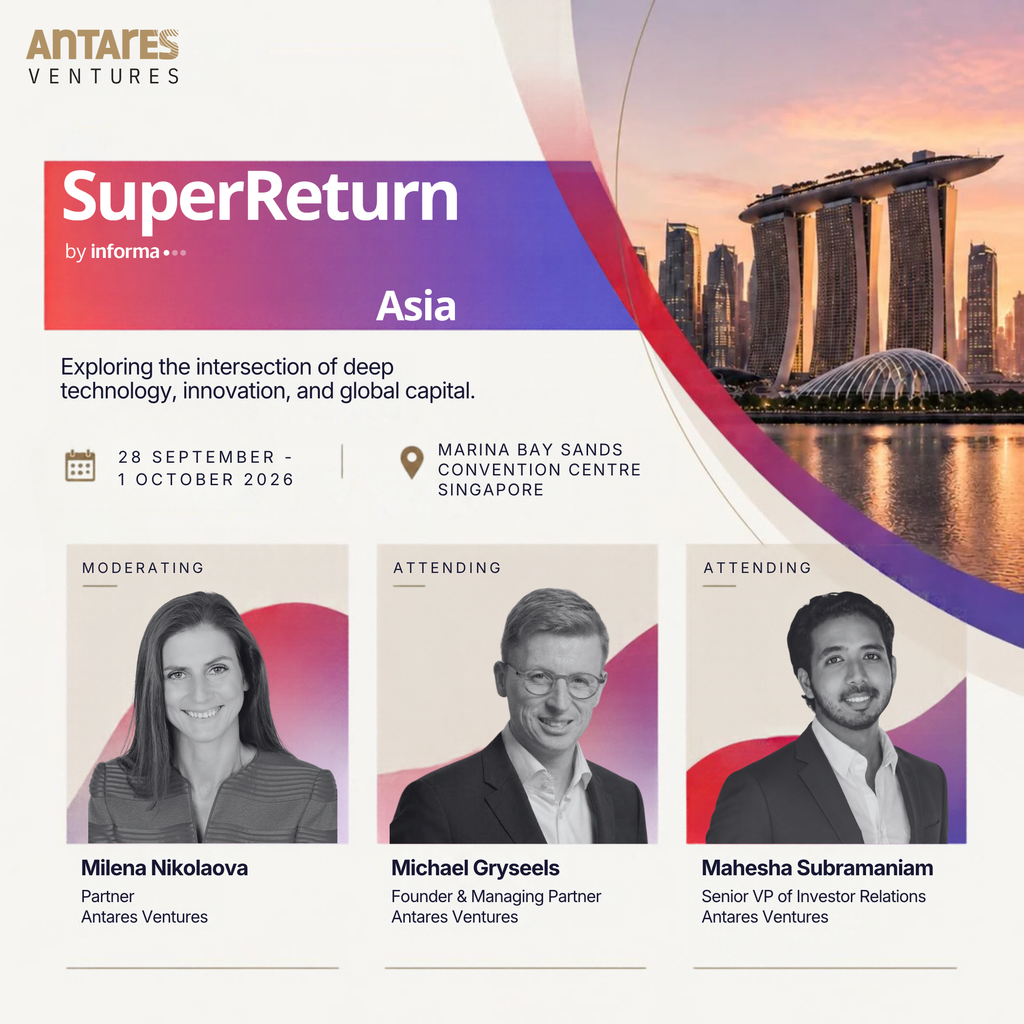
SuperReturn Asia returned to Singapore this year, held at Marina Bay Sands Convention Centre from 28 September to 1 October 2026. The event drew more than 2,500 senior attendees from over 50 countries, among them more than 1,200 LPs and more than 1,000 GPs.
Across the four days, the programme spanned private equity, venture capital, private credit, secondaries, liquidity solutions, and AI and deep tech, with specialist summits and co-located programmes such as Family Office Asia running alongside the main conference.
For Antares, one question ran through many of the week’s conversations: what it will take to build the infrastructure behind growing compute demand, and to do so sustainably. The data centre build-out ahead is extraordinary in scale. Delivering that capacity economically depends on solving real technological and infrastructure bottlenecks.
Our Managing Partner Michael Gryseels, Partner Milena Nikolova, and Senior VP of Investor Relations & Chief of Staff Mahesha Subramaniam joined SuperReturn Asia week in Singapore, taking part in conversations on deep tech, the future of sustainable data centres, and the infrastructure needed to support growing demand.
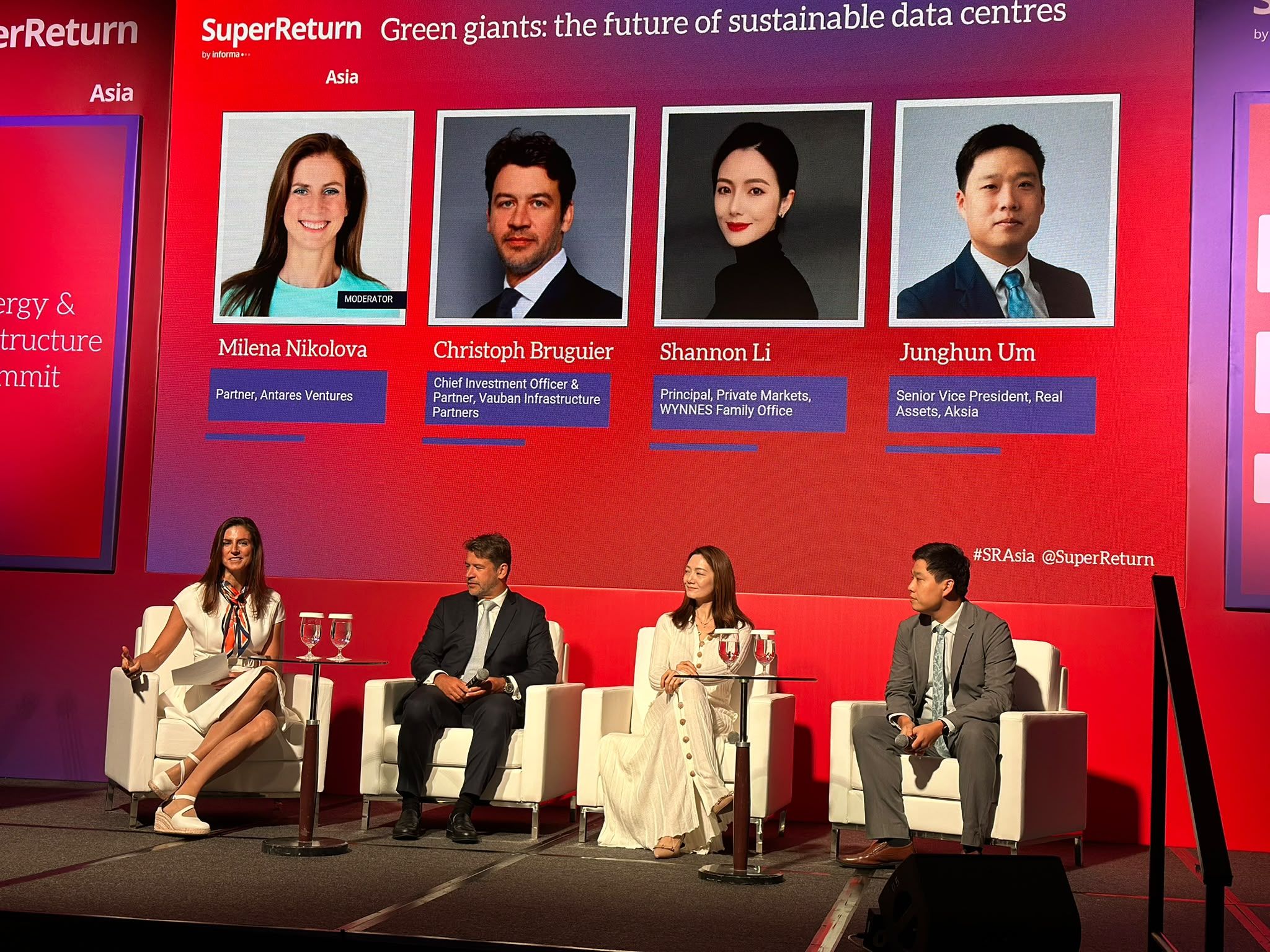
As part of the programme, Milena moderated the panel “Green Giants: The Future of Sustainable Data Centres” alongside Christoph Bruguier of Vauban Infrastructure Partners, Shannon Li of WYNNES Family Office, and Junghun Um of Aksia. The session looked at the challenges of moving data centres from high energy consumption to sustainable operations, the role of governments and the private sector in resilient data centre development, and how the push for sustainable data centres differs between Asia and other markets.
The panel brought together perspectives from infrastructure ownership, family-office capital, institutional allocation, and venture. One point of agreement was that not all announced capacity will be built or prove economically viable. Christoph and Junghun pointed to constraints around power, grids, permitting, equipment, and economics. The shift from training to inference adds another layer: more compute will need to sit closer to users, and some countries are better prepared for this than others. Shannon highlighted the need for enabling solutions, as some of the most interesting opportunities may sit around the data centre rather than in it.
Antares sits across the point where energy, compute, and industrial systems meet. In compute, the focus is on the materials, power delivery, cooling, advanced packaging, and real-asset infrastructure that physically enable scale. In data centres, this means the bottlenecks around compute infrastructure, from energy efficiency and resource optimisation to the technologies that make large-scale deployment more viable.
Sustainability has to make economic sense. The solutions that scale will be those where sustainability and economics reinforce each other by reducing costs, improving resilience, or unlocking capacity.
Data centre capacity does not end at the facility. It depends on the systems around it that make the facility possible.
***
If you were at SuperReturn Asia, or work and invest around deep tech and infrastructure, we welcome the conversation. CONTACT US.