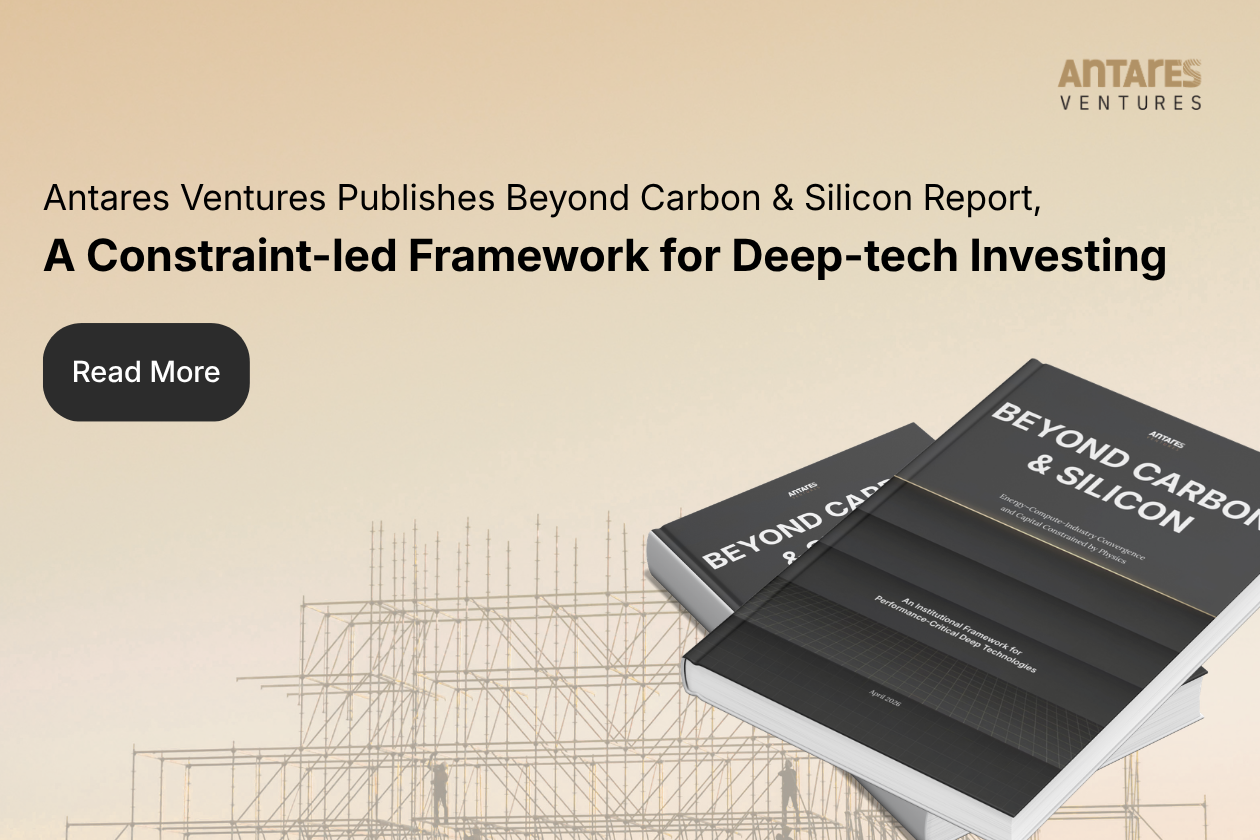
New report identifies where deep tech can unlock capital productivity across Asia as energy, compute and industrial systems converge
SINGAPORE — Antares Ventures, a specialist deep-tech venture capital firm that invests globally and helps companies scale across Asia, today published Beyond Carbon & Silicon, a report formalising its deep tech investment framework for identifying technologies that can unlock performance across capital-intensive energy, compute and industrial systems.
The report argues that AI, electrification and advanced manufacturing are driving a major reinvestment cycle across grids, data centres, factories, semiconductor capacity and AI infrastructure. However, the returns on that capital will increasingly depend on whether four physical constraints—power, thermal management, materials and system control—can be overcome.
“For decades, carbon expanded the world’s physical productive capacity while silicon improved how that capacity was coordinated and used,” said Michael Gryseels, Founder and Managing Partner of Antares Ventures. “Those systems can no longer be considered separately. AI infrastructure is constrained by power and cooling, while modern energy systems increasingly depend on compute and control. In this investment cycle, capital is already moving. Performance is the constraint.”
Asia is central to the framework. The region combines rapid growth in energy demand, compute infrastructure and industrial capacity with high asset utilisation, dense urban environments and significant infrastructure variance.
Across many Asian markets, heat, humidity, grid constraints and limited operating slack expose performance gaps earlier. This makes the region not simply an end market for deep technology and energy transition technologies, but a demanding deployment environment in which technologies can demonstrate whether they are capable of operating reliably and scaling commercially.
“Asia is where scale, constraint and demand intersect,” Gryseels said. “Technologies that perform under these conditions can build compelling evidence of their relevance elsewhere.”
Capital is moving, bottlenecks determine outcomes
The report examines how the scaling of AI infrastructure and computing capacity is becoming increasingly dependent on physical infrastructure. Power availability, grid connections, cooling capacity, land, water and system reliability now influence how quickly new compute capacity can be deployed and how productively it can operate.
According to the International Energy Agency, global electricity consumption by data centres is expected to double by 2030. The capital expenditure of five largest hyperscalers is expected to exceed US$1 billion in 2026. At this scale, compute infrastructure is built, powered, cooled and financed increasingly like heavy industry rather than as a purely digital layer.
The relationship also works in the opposite direction. Advances in energy increasingly depend on computing, from accelerated materials discovery and grid orchestration to thermal optimisation, forecasting and the coordination of distributed assets. Energy and compute have become part of the same operating system, with constraints in one layer propagating across the others.
“Capital can fund the platforms,” Gryseels said. “But if power, thermal, materials and control constraints are not resolved, utilisation falls, costs rise and returns leak away. Deep technology is the performance layer that can make the capital already being deployed work harder.”
Where deep technology becomes economically decisive
The framework identifies four constraint layers where science- and engineering-led breakthroughs can have outsized economic impact:
Power: Increasing available capacity, power density, conversion efficiency and grid stability.
Thermal: Removing cooling and heat-rejection limits that restrict usable capacity.
Materials: Improving efficiency, durability and performance under demanding operating conditions.
Control: Coordinating tightly coupled assets to improve reliability, utilisation and uptime.
These challenges are creating demand for energy transition technologies that can improve resilience, efficiency and reliability across critical infrastructure.
The report argues that deep technology is economically decisive when it clears a binding bottleneck in infrastructure that is already being built, shaping how deep tech investment decisions should be evaluated. It therefore recommends that deep tech venture underwriting place greater weight on technical proof, performance under real operating conditions, integration risk, deployment economics and the clarity of the commercial adoption pathway.
This approach reflects Antares Ventures’ broader deep tech investment philosophy: focusing on technologies where technical performance directly addresses commercial constraints.
“The opportunity is not deep tech in the abstract,” Gryseels concluded. “It is technology attached to a constraint that customers already need to solve. When the bottleneck is real and the performance advantage is proven, adoption becomes much less discretionary.”
***
About Antares Ventures
Antares Ventures is a specialist deep-tech venture capital firm investing globally in science- and engineering-led companies across energy, compute, industry, and urban and natural infrastructure.
With an Asia-first value-creation model, Antares actively supports portfolio companies through governance, industrial partnerships and commercial deployment across the region. Its constraint-led investment approach focuses on technologies that improve the efficiency, reliability and performance of critical infrastructure systems.
Deep Tech. For Asia.
Built to Matter.
For more information, visit www.antares.ventures.